

Bemotrizinol is the first new sunscreen filter the FDA has approved in 20 years. Here is what the evidence does and does not tell us about using it in pregnancy.
Navigating pregnancy-safe skincare can be complicated, but as a medical doctor with a focus on cosmetic ingredient safety, I’ve simplified the search for you. Visit my Skincare During Pregnancy: Begin Here guide for a full index of ingredient safety reviews, pregnancy and IVF-safe recommendations, and doctor-vetted product guides.
Bemotrizinol, also known as BEMT, Tinosorb S, and Parsol Shield, has earned the distinction of being the first sunscreen active to be FDA-approved in the last 20 years. While a monumental step forward, it also highlights the sluggish pace of regulatory approvals, especially considering that this filter has been safely and effectively used in Europe and Asia for decades.
Quick answer: is bemotrizinol pregnancy-safe?
The available evidence is reassuring, but bemotrizinol has not been directly studied in pregnant women. Below, I explain what the research tells us and where uncertainty remains.
Quick Navigation
The Basics
What is bemotrizinol?
A chemical sunscreen filter with the full name of bis-ethylhexyloxyphenol methoxyphenyl triazine (and which is why no one actually uses it), BEMT is a broad-spectrum UV filter in a single ingredient!
Most filters block only part of the UV spectrum, so they have to be stacked to be effective, resulting in multiple chemical sunscreens listed on the bottle as actives.
Europe, Asia, and Australia have been using it for a long time. In the USA, the FDA approved it in June 2026.
It is popularly known as Parsol Shield or Tinosorb S in the overseas market.
Why It Stands Out
The incomparable advantages of bemotrizinol
Filters both UV-A and UV-B, making it a broad-spectrum sunscreen. So if you buy a sunscreen with bemotrizinol, the active ingredient list will include only this one ingredient, unlike many sunscreens today, which list multiple chemical filters (avobenzone for UV-A and octinoxate, octisalate, octocrylene, and others for UV-B). Another broad-spectrum UV filter is zinc oxide.
It is photostable, meaning it doesn’t degrade into byproducts that can trigger irritation in sensitive skin, sting the eyes, or lose efficacy quickly over time.
It is cosmetically elegant (no chalky, thick texture or white cast), which another truly broad-spectrum sunscreen, zinc oxide, utterly lacks.
Lower risk of eye and skin irritation than other chemical sunscreen ingredients.
For example, avobenzone is notorious for eye stinging, as it dissolves in skin oil and sweat and migrates into the eye’s sensitive mucosa, and standard chemical filters are not photostable and require chemical additives to stabilize the formula. These additives add to the risk of triggering allergic reactions.
Bemotrizinol is a strong, broad-spectrum UV filter on its own and is highly photostable, so it does not break down or require other additives, reducing the risk of contact allergies or dermatitis.
It is a large-sized molecule and thus, absorption into the bloodstream is expected to be much less than the traditional chemical filters we have been using.
The Trade-Offs
The negatives
Bemotrizinol has a lower risk of allergic reactions than standard filters and is less irritating; however, some users may still experience rashes and allergic reactions. This could be due to bemotrizinol itself or due to other ingredients in the sunscreen formulation.
It does not block visible light, so it does not replace tinted sunscreens, especially if you are prone to melasma or want to manage active melasma.
Learn more:
Melasma in Pregnancy: Causes and Prevention.
Pregnancy and Nursing Safe Melasma Treatments.
Best Pregnancy-Safe Tinted Mineral Sunscreens.
The Verdict
So, is bemotrizinol pregnancy safe?
The FDA approved bemotrizinol in June 2026 at a concentration of 6% for adults and children over 6 months of age.
I reviewed all the medical literature I could find, and what I found doesn’t match what marketing suggests.
For example, in this statement I found on an online skincare store, one would think bemotrizinol is tried, tested, and backed by scientific studies.
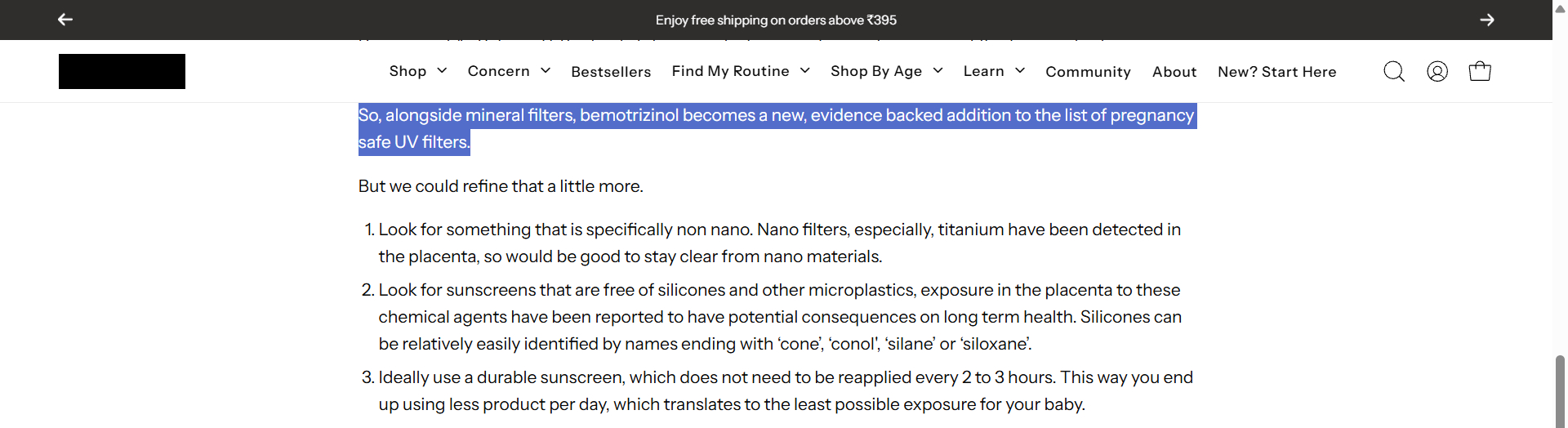
The fact is, no human studies examine the relationship between bemotrizinol and pregnancy.
No trials, no breast milk measurements, no follow-up on the babies.
This is not unusual. This is what is true of almost all cosmetic ingredients because you cannot run experiments on pregnant women.
What we do have are these:
Absorption data
500 Dalton Rule
Hormone data
The Evidence
Absorption data
This 2023 MUsT study (Maximum Usage Trial study measuring how much topical medication absorbs into the bloodstream under maximum usage conditions) showed that the BEMT concentration rarely crossed a level the FDA considers significant, and there was no sign of the chemical accumulating in the body over time.
The conflict of interest
To be fully transparent, the company that sells the ingredient funded the study, and the author list includes people who are directly or indirectly employed by the company.
That doesn’t make the results wrong or invalidate the findings, though!
In fact, what gives me confidence in this study is the scientific principle known as the 500 Dalton Rule.
The Evidence
500 Dalton Rule
The 500 Dalton Rule for skin penetration of chemical compounds and drugs states that compounds with molecular weights above 500 Da typically do not penetrate intact skin, which is a very effective barrier.
Arguments that favor this rule are:
Skin allergies come only from tiny particles that are under 500 Da.
Topically applied creams or ointments are all under 500 Da.
Medicated skin patches (nicotine or estrogen hormone patches) use molecules smaller than 500 Da.
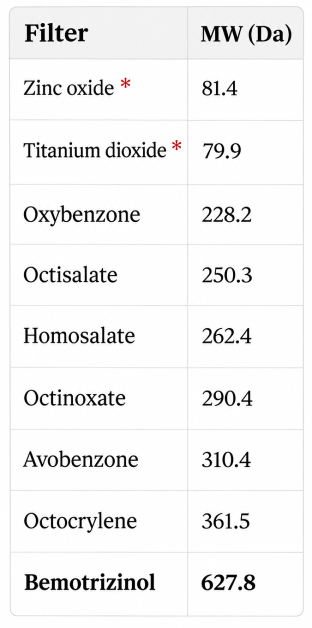
Here is where various sunscreen filters stand:
 Source: PubChem
Bemotrizinol at 627.8 daltons is well above this threshold, so absorption is expected to be limited.
*Going back to the chart, you can see zinc oxide and titanium dioxide well below the 500 Da threshold, and you are right to wonder how these two are considered safer to use in pregnancy compared to the other chemical filters that are much larger?
This is because, in sunscreens, they don’t exist as a single molecule; they bind together to form large physical particles that are much larger than 500 Da. They are also largely insoluble and less likely to break into individual molecules in water, sweat, or skin oil.
The Evidence
Hormone data
This 2001 study tested Tinosorb S (BEMT) against hormone receptors and found no binding or activity. This matters because hormone disruption is a specific concern with older chemical filters like oxybenzone, and it does not apply here.
Based on the above, BEMT absorption from intact skin is expected to be low, producing low bloodstream levels and making it a reassuringly safer option than existing chemical filters for pregnant women.
Learn more:
Are Sunscreens Pregnancy Safe?
Head To Head
Is it as safe or safer than zinc oxide?
If you want a simple answer, zinc oxide still wins.
Not because bemotrizinol is risky, but because zinc oxide sidesteps the question entirely and also provides a robust, full-spectrum protection against UV rays.
However, if you hate how mineral sunscreen feels and looks, and end up skipping it most of the time or applying it poorly, that is a legitimate concern too, because poor sun protection increases the risk of melasma.
A formula containing bemotrizinol that will be regularly used is superior to a mineral one that will lie unused in your drawer.
This is my personal opinion, and your OB will be the right person to guide you here.
Learn more:
Are Nano Zinc Oxide and Titanium Dioxide Sunscreens Safe to Use in Pregnancy?
Best Pregnancy-Safe Non-Tinted Zinc Oxide Sunscreens.
While Nursing
Is bemotrizinol safe while breastfeeding?
No direct human studies currently measure bemotrizinol in breast milk. However, the low absorption through intact skin is reassuring.
Avoid applying it directly to any area that may come into contact with the baby’s mouth.
Always ask your healthcare provider if you have concerns about a specific sunscreen formula.
Trivia
What the 500 Dalton Rule says about collagen creams
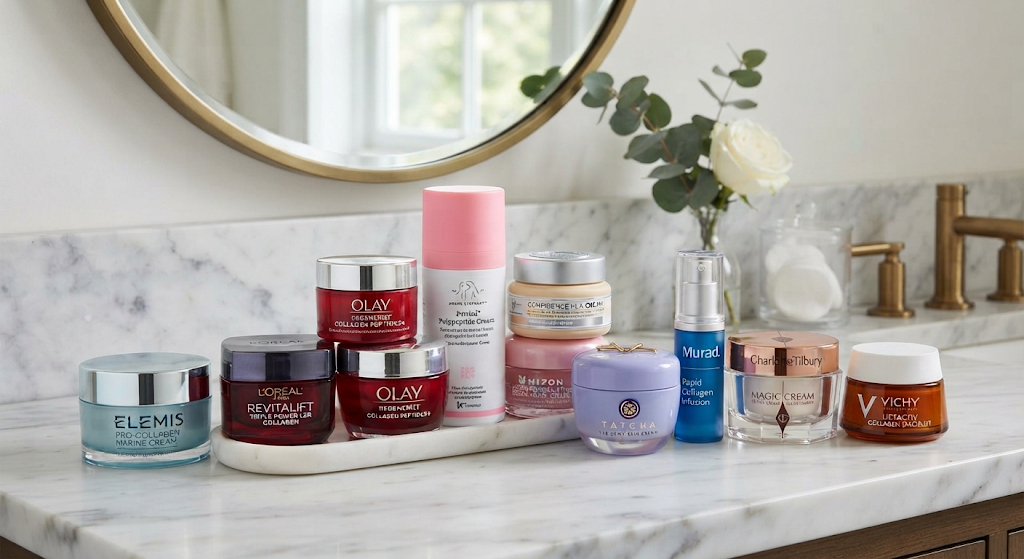
Spending $$$ on a collagen cream? The 500 Dalton Rule applies here too. At 300,000 daltons, collagen is too big to penetrate the skin to have any actual effect.
You still feel it works? Take a close look at the ingredient list: see all those actives listed there (vitamin C, niacinamide, hyaluronic acid, and so on)? Those are what’s impacting your skin, not the collagen itself!
(Although collagen does have a humectant effect and pulls moisture to your skin surface, that is no reason to spend all that money on something that can be done by glycerin at a fraction of the cost.)
FAQ
Frequently asked questions
Is bemotrizinol pregnancy-safe?
The available evidence is reassuring, but bemotrizinol has not been directly studied in pregnant women. No human studies examine the relationship between bemotrizinol and pregnancy: no trials, no breast milk measurements, and no follow-up on the babies. What we do have is absorption data, the 500 Dalton Rule, and hormone data, and based on those, BEMT absorption from intact skin is expected to be low.
What is bemotrizinol?
Bemotrizinol, also known as BEMT, Tinosorb S, and Parsol Shield, is a chemical sunscreen filter with the full name bis-ethylhexyloxyphenol methoxyphenyl triazine. It is a broad-spectrum UV filter in a single ingredient, and the FDA approved it in June 2026 at a concentration of 6% for adults and children over 6 months of age.
Why does molecular size matter for sunscreen safety?
The 500 Dalton Rule states that compounds with molecular weights above 500 Da typically do not penetrate intact skin. Bemotrizinol sits at 627.8 daltons, well above that threshold, so absorption is expected to be limited.
If zinc oxide is only 81.4 Da, why is it considered safe?
In sunscreens, zinc oxide and titanium dioxide don’t exist as a single molecule. They bind together to form large physical particles that are much larger than 500 Da, and they are also largely insoluble and less likely to break into individual molecules in water, sweat, or skin oil.
Is bemotrizinol safer than zinc oxide during pregnancy?
If you want a simple answer, zinc oxide still wins, not because bemotrizinol is risky, but because zinc oxide sidesteps the question entirely and provides robust, full-spectrum protection. That said, a bemotrizinol formula you will actually use regularly is superior to a mineral one that lies unused in your drawer.
Is bemotrizinol safe while breastfeeding?
No direct human studies currently measure bemotrizinol in breast milk, though its low expected absorption through intact skin is reassuring. Avoid applying it directly to any area that may come into contact with the baby’s mouth, and always ask your healthcare provider if you have concerns about a specific formula.
Does bemotrizinol protect against melasma?
It does not block visible light, so it does not replace tinted sunscreens, especially if you are prone to melasma or want to manage active melasma.
Questions about your sunscreen?
If you would like a quick, doctor-vetted review of a sunscreen’s ingredient list, or help deciding between a mineral filter and a newer chemical one during pregnancy, I would love to help.