Picking out pregnancy-safe skincare can seem complicated. I have an entire page on pregnancy beauty, dedicated to which skincare ingredients to avoid during pregnancy, breastfeeding, or IVF.
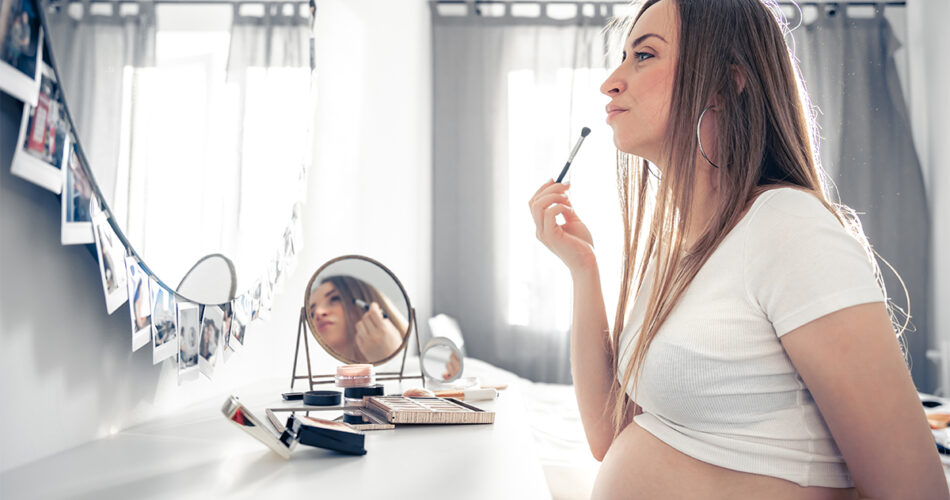
Today is about makeup and pregnancy. If you enjoyed wearing makeup before getting pregnant, you will naturally want to continue using it during your pregnancy, and you might be wondering if makeup is safe for pregnancy.
Generally speaking, you can wear makeup while pregnant.
For pregnancy-safe makeup, you just need to screen out a few chemicals from your products, as anything you apply to your skin can transfer to your baby. Thus, you might want to reevaluate your makeup products and avoid certain ingredients during pregnancy or when planning a pregnancy.
Quick Navigation
Is makeup really safe to use while pregnant?
While we do not have much information on how cosmetics affect the baby in utero, we know that most cosmetics are safe to use. However, we do not know how much of these cosmetics is too much as there have (of course) been no experimental studies on pregnant women.
There have been a few observational studies on the effects of cosmetics on pregnancy. I will link some of these articles here:
- Maternal use of cosmetics during pregnancy and a positive correlation with small for gestational age babies.
- Low birth weight infants in cosmetologists.
- Reproductive disorders among cosmetologists and hairdressers.
Note that these studies are purely observational, and the mothers in these studies have been exposed to other chemicals in cosmetics that are known to be unsafe for pregnancy.
A lot goes into making pregnancy-safe makeup. I have two blog posts about chemicals in cosmetics to avoid that I will link here:
- Part I: Pregnancy Safe Skincare- Avoid These Ingredients.
- Part II: Pregnancy Safe Skincare- Avoid These Ingredients.
The above lists include the following chemicals:
- Alpha Hydroxy Acid (AHA) in high percentage
- Beta Hydroxy Acid (BHA) / Salicylic acid in high percentage
- Chemical Sunscreens
- Essential oils / Aromatherapy
- Hydroquinone
- Phthalates or added fragrance
- Retinoids
- Triclosan
- Formaldehyde & methylene glycol
- Formaldehyde releasers
Parabens are as controversial as they come, and I have a separate post on them: Are Parabens in Cosmetics Safe to Use?
The thing specific to makeup you should worry about? Lead
Lead occurs naturally in the environment, and lead contamination of cosmetic products is more common than we think.
It is also one of the important makeup ingredients to avoid during pregnancy, as it can pass through the placenta and into breast milk.
Although the FDA considers that ‘up to 10 ppm lead in cosmetic lip products and externally applied cosmetics would not pose a health risk’, there is no defined safe level of lead, and exposure to lead during pregnancy can be deleterious.
It can cause:
- Miscarriage
- Hypertension during pregnancy
- Preterm delivery
- Small for gestational age baby
- Damage to the baby’s kidneys and the nervous system
- Behavioral and learning disabilities in the offspring.
While eliminating lead exposure may not always be feasible, you can take some measures that will reduce your exposure to it through cosmetics.
Lipsticks
You will be licking your lips and ingesting your lipstick throughout the day.
Lead finds its way into colored cosmetics like lipstick, as the minerals and ores used to make them naturally contain lead. There is no known safe blood lead concentration.
Note that the FDA considers lead less than 10 ppm in cosmetics harmless.
Shimmery lip products tend to contain high lead levels, possibly because lead minerals naturally occur in the soil alongside mica, which adds sparkle to such products.
Some tests showed that browns and bright pink shades tend to have higher lead levels than other colors.
Surma, Kajal, Kohl, Tiro
These traditional eyeliners, popular in the Indian subcontinent, Africa, and the Middle East, provide rich, long-lasting pigmentation and are the top makeup to avoid during pregnancy.
They often contain high levels of lead, which may account for more than half of the product’s weight, as evidenced in this case report!
They have entered the US market despite the FDA’s import alert, and consumers should be aware and avoid using them.
Talc and asbestos in makeup products
Talc, a naturally occurring mineral, is a common ingredient in makeup products such as powders, eyeshadows, blushes, and liquid makeup.
They absorb moisture, prevent caking, and create a soft, silky texture.
However, talc can be contaminated with asbestos, another naturally occurring mineral that can cause cancer, such as mesothelioma and ovarian cancer.
We do not have enough information about the consequences of using talc contaminated with asbestos during pregnancy in makeup.
Using talc-based makeup is mainly at one’s discretion, and talc as a cosmetic ingredient is never really screened out by your doctor’s office during antenatal visits.
However, talc-free makeup brands (Honest Beauty, Juice Beauty) are available should you choose to avoid talc.
I have always avoided talc-based products as a personal choice.
Tips for makeup that is safe during pregnancy
- Do not buy cheap makeup online from websites like Temu or Shein.
- Always choose fragrance-free products.
- Avoid certain pregnancy-unsafe chemicals in your skincare products (listed at the beginning of this blog)
- While choosing a foundation with SPF, choose only those with mineral sunscreen (Zinc oxide or titanium dioxide)
- Little is more! Go easy on your makeup and avoid a heavily made-up look.
- Higher-priced products do not necessarily mean safer products.
- Never use expired makeup or share makeup.
- Avoid imported eye products labeled as surma, kajal, kohl, or tiro.
- Shimmery makeup and brown and bright pink shades might contain high lead levels.
- Speak to your doctor about product safety.
Trivia

Kajal or surma in the Indian subcontinent is used very commonly in infants as a measure to ward off the evil eye that is traditionally blamed for all kinds of ailments in the baby.
It is applied to the eyes and dotted on the forehead, cheeks, and temples.