

Quick Navigation
What are retinyl, retinol, and retinal?
Picking out pregnancy-safe skincare can seem complicated. I have an entire page on pregnancy beauty, dedicated to which skincare ingredients to avoid during pregnancy, breastfeeding, or IVF.
Today is about retinoids. Retinyl, retinol, and retinal- all 3 are types of retinoid, a group of chemicals similar to vitamin A.
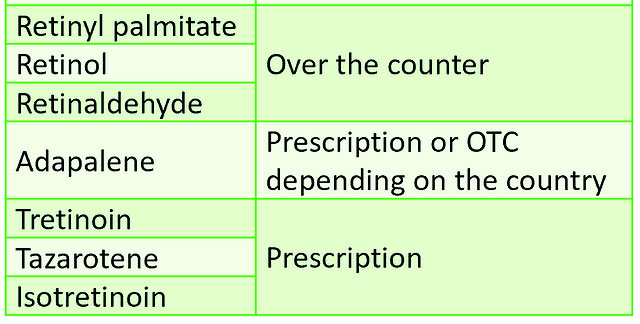
Depending on the potency, retinoids, including those leading you to wonder ‘is retinol safe during pregnancy,’ can be either prescription only or over the counter.
Retinoids can be oral medicines as well as topical applications.
Retinyl, retinol, and retinyl are over-the-counter topical retinoids found in many commercially available cosmetic beauty skin creams and body lotions.
Retinoids are a favorite with every skincare junkie because of their multiple skin benefits:
- Collagen generation for anti-aging benefits,
- Exfoliant action stimulates the dead skin cells to slough off, revealing new, fresh skin
- Reduced oil production that helps with acne
- Inhibit the enzyme tyrosinase essential for melanin production, thus helping with hyperpigmentation problems like melasma.
What is the concern with retinyl, retinol & retinal in pregnancy?
Retinol belongs to a group of chemicals called retinoids, chemically related to vitamin A.
Some members of this group, particularly oral formulations like isotretinoin, have shown a positive association with fetal abnormalities when pregnant women use it.
This is known as Fetal Retinoid Syndrome or Retinoid Embryopathy, which shows multiple abnormalities involving the facial structures like the ear, lip, and palate, heart defects, brain abnormalities, learning disabilities, etc.
Depending on the type of retinoid, it can fall into the following two FDA categories for use in pregnancy:
Category C: Risk cannot be ruled out. There are no satisfactory studies in pregnant women, but animal studies demonstrated a risk to the fetus; the potential benefits of the drug may outweigh the risks.
Topical retinoid: Tretinoin (Retin-A™) and adapalene (Differin™)
(Pharmacokinetic studies show relatively low systemic exposure from topical retinoids, but the exposure levels that could lead to teratogenicity in humans are unknown.)
Category X: Contraindicated (studies in pregnant women have demonstrated a risk to the fetus, and/or human or animal studies have shown fetal abnormalities; risks of the drug outweigh the potential benefits).
Topical retinoid: Tazarotene (Tazorac™)
Oral retinoid: Isotretinoin (Accutane™, Claravis™), etretinate, etretin.
The above retinoids are, thus, contraindicated in pregnancy.
Currently, there is no understanding of how harmful retinyl, retinol, or retinal, as found in cosmetic creams, are. The studies published are on oral and prescription topical retinoids.
However, since these belong to the same group as the ones that have shown birth defects when used in pregnancy, the caution extends to all retinoids- whether over-the-counter or prescription-based.
While the AAD (American Academy of Dermatology) only lists oral and prescription retinoids as unsafe medications during pregnancy, a favorable risk vs. benefit ratio is not there to recommend using retinol, retinyl, or any other retinoids in pregnancy.
Till scientific data backs the safety of retinol and retinyl, it is advisable not to use them when pregnant or planning a pregnancy.
How long before pregnancy should I stop using my retinol cream?
It is recommended that oral retinoids be stopped one month before trying to get pregnant.
This recommendation extends to prescription topical retinoids, too.
There is currently no separate recommendation for retinyl, retinol, or retinal when applied topically. When applied on the skin, unless the skin is broken or has conditions like dermatitis, much less makes it into the bloodstream.
Both are, however, in FDA pregnancy category C, meaning that the risk to the fetus cannot be ruled out. It is prudent to stop using it for at least a month before you start trying to get pregnant.
Drug elimination from the body depends on person to person.
Every person has a different metabolism and may process drugs differently.
There has been a published report of fetal malformation even after adhering to the prescribed one month, which has resulted in the suggestion of a long duration of oral retinoid discontinuation of 3 months.
I used a retinol skin cream while pregnant. What to do now?
First, don’t panic. Secondly, stop using it.
There have been isolated reports of fetal abnormalities with topical prescription retinoids (adapalene and tretinoin) that resemble findings similar to those seen with exposure to oral retinoids.
However, at the same time, some studies have failed to demonstrate a definitive link.
For example, in this study that observed 654 pregnant women exposed to topical retinoids and 1375 who were not, there was no significant increase in congenital malformation rates in the exposed group.
Weaker retinoids like retinyl, retinol, or retinyl in your skin creams, so far, have no documented fetal anomalies associated with them.
Chances are that no harm has been done, and there is no need to worry.
In such situations where inadvertent exposure in pregnancy has occurred, the available data provide some reassurance that adverse pregnancy outcomes are unlikely.
However, it is essential to note that none of these studies state it is safe to use when pregnant, and that there is no statistical justification for using retinoids in pregnancy. Thus, inform your obstetrician so that your follow-up visits and investigations, like an ultrasound, can consider retinoid use.
Takeaway
- Retinyl, retinol, and retinal belong to a group of chemicals known as retinoids, which include these over-the-counter as well as prescription-only chemicals like
- Oral retinoids are positively associated with fetal abnormalities when used in pregnancy.
- Such associations have also been reported with topical prescription retinoids.
- So far, there are no reports of fetal abnormalities with retinyl, retinol, or retinal, as found in commercially available cosmetic skin creams. Still, they should not be used in pregnancy till studies prove conclusively that they are safe to use when pregnant.