
Now that you are done with pregnancy, would you like to bring back your favorite pre-pregnancy creams to your skincare routine?
While we know how chemicals (and even microplastics!) can pass through the placenta to the baby, what about through the breast milk? Read on to learn about safe skincare for breastfeeding moms.
Quick Navigation
How does nursing skincare differ from pregnancy skincare?
Skincare for nursing moms is much less restrictive than pregnancy skincare, and the list of products you can use is much more flexible.
Chemicals, however, still pass from your breastmilk to your baby, and thus the restrictions.
Nearly all medications taken orally are transferred to breastmilk in varying degrees, depending on their pharmacological profile. Generally speaking, topical preparations like creams are expected to have lower concentrations than oral ones.
Skincare ingredients to avoid while nursing.
Oral Retinoids
Oral retinoids are not recommended while breastfeeding. They are fat-soluble and can cross biological barriers and enter the breastmilk.
Breastfeeding should be avoided while on oral retinoids and for 1 week after the last dose.
Use of vitamin A derivatives like retinoids has been associated with retinoid toxicity in the breastfeeding infant.
Infants with this syndrome can suffer from increased intracranial pressure, skin peeling, vomiting, with chronic exposure causing growth retardation, enlargement of the liver and spleen.
The label will read:
Isotretinoin, acitretin, alitretinoin, bexarotene, amongst others.
Hydroquinone
Hydroquinone, contraindicated in pregnancy, is not contraindicated during nursing per se, but its long-term use during nursing is not recommended as a routine. At present, there is no data available about its effects on nursing. This can be disappointing for mothers suffering from melasma (pregnancy-induced hyperpigmentation), as hydroquinone is one of the first-line drugs for treating it. However, there are other nursing-safe skincare options available.
Discuss it with your doctor if you still feel it is an option.
Here is more information on managing melasma or pregnancy-induced hyperpigmentation:
Melasma in Pregnancy: Causes & Prevention.
Pregnancy & Nursing Safe Melasma Treatment.
Top 10 Pregnancy & Lactation Safe Sunscreens for Melasma & Hyperpigmentation.
The label will read:
Hydroquinone.
Hemp or Cannabis based skincare.
In the world of skincare, it is important to differentiate between hemp seed oil and cannabis / CBD extracts.
1) Hemp seed oil
Generally safe to use as it is derived from the seeds of the Cannabis sativa plant and has no or trace amounts of CBD and THC. The FDA clearly states that, ‘Hemp seeds can pick up minuscule amounts of THC and CBD from contact with other plant parts, but these amounts are low enough to not raise concerns for any group, including pregnant or breastfeeding mothers.’
In summary, hemp seed oil-based products are safe. However, if you are concerned about potential trace amounts of THC or CBD, opting for a complete avoidance of cannabis-derived ingredients is a perfectly valid choice for your peace of mind
2) Cannabis or CBD extracts
CBD and other cannabinoids, like Tetrahydrocannabinol (THC), are derived from the leaves and flowers of the plant.
THC and CBD are fat-soluble and can pass into breast milk, which is high in fat. Research clearly shows that they can be detected as early as 1 hour after use and can linger for up to 6 days.
THC and CBD accumulate in breast milk, reducing breast milk supply, and can lead to cognitive, social, and motor defects in the breastfeeding infant.
The FDA is unequivocal in stating that “FDA strongly advises against the use of cannabidiol (CBD), tetrahydrocannabinol (THC), and marijuana in any form during pregnancy or while breastfeeding.”
Others
Ingredients such as phthalates, chemical sunscreens, and formaldehyde and formaldehyde releasers are best avoided during pregnancy. As for while beastfeeding, we do not have enough information about how much of these gets into breast milk and, thus, whether they can be considered part of nursing-safe skincare or not.
If you do choose to continue avoiding these chemicals during breastfeeding, it is a sound and proactive decision for your peace of mind.
What about topical Retinoids?
It is unknown how much topically applied retinoids can pass into breast milk.
However, based on current evidence, some topical retinoids do not appear to be significantly excreted into breast milk and may be safe to use.
Discuss introducing topical retinoids into your skincare regimen with your doctor.
Lately, Bakuchiol has exploded in popularity in the skincare market as a safe alternative to retinoids for pregnancy and nursing. Should it be part of your skincare routine as a nursing mom?
Here is more about it:
Safety Profile of Bakuchiol in Pregnancy & Nursing.
Bonus content:
I struggled with my milk supply, and these were so addictive!
Finding Lactation Cookies- Aussie Bites From Costco.
Precautions while using nursing-safe skincare products.
- Unless it is breastfeeding-friendly, keep your skincare product away from your breasts and nipples.
- Remember that any product you apply to your skin can transfer to the baby, even while you play and interact with your baby. A baby’s skin is very delicate and can react adversely to various chemicals in the product. For example, salicylic acid. While it may work wonders for your acne, it can irritate and dry your baby’s delicate skin.
The thing to really worry about? Your medications.
You should look into the medication you are taking. It is estimated that 96% of breastfeeding women use one or more medications. How much of the medication consumed reaches the breast milk depends on how the drug is metabolized and excreted from your body and other factors specific to the medicine, like its weight, protein binding capacity, pH, and lipophilicity.
LactMed- The Drugs & Lactation Database contains relevant information on drugs and other chemicals that lactating moms are exposed to and the possible effects they may have on the infant.
This database also provides alternatives to the drugs, where applicable. All the data is peer-reviewed for accuracy and collated from scientific literature.
You can also refer to the FDA Drug Categories for Drug Safety in Pregnancy & Nursing.
Trivia
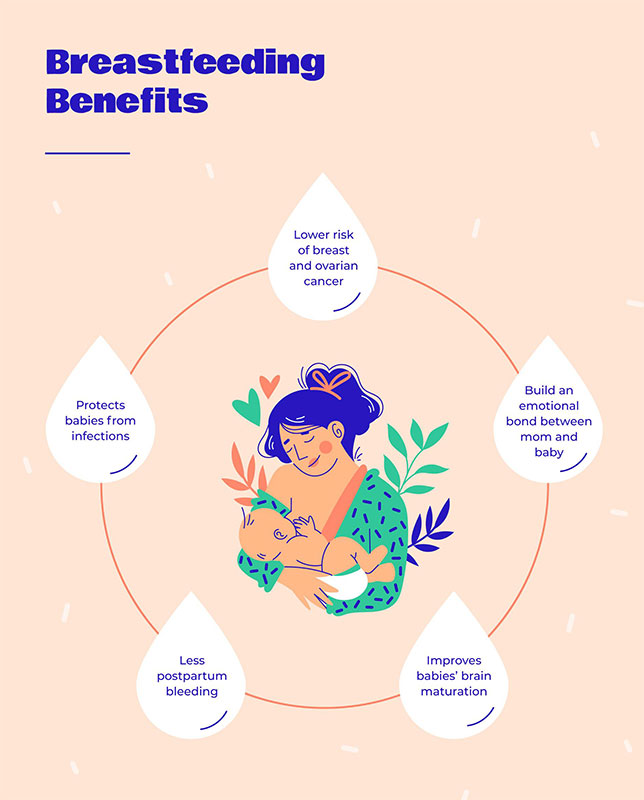
Breastfeeding benefits both the baby and the mother.
It has been shown to reduce the risk of diseases in the baby, such as childhood leukemia, hypertension, necrotizing enterocolitis, ear infections, respiratory diseases like asthma and respiratory infections, sudden infant death syndrome, diabetes, and dermatitis.
Neurological benefits include better memory, early language and motor skills, and higher IQ.
For the mother, it leads to reduced postpartum bleeding and faster uterine involution. It may also lead to more rapid weight loss and a reduction in postpartum depression risk. Breastfeeding leads to lower rates of obesity, type II diabetes, hypertension, hyperlipidemia, cardiovascular disease, and breast and ovarian cancer.