

(News update on PFAS: REI axes PFAS from all inventory. REI will now require its suppliers to cut PFAS from all cookware, apparel, shoes, etc., by Fall 2024 to 2026, depending on the product line)
The post today is a public service announcement about period panties.
In a previous post, Good Menstrual Hygiene Practices, I answered common queries on menstrual hygiene, like how often should a menstrual device(pad/tampon/cup) be changed, Toxic Shock Syndrome and sleeping overnight with tampons, or having sex during periods, or safe disposal of tampons and pads, etc.
In the post, I also wrote about period panty as protective underwear with a leakproof layer to be used with your tampon/pad/cup. This panty just replaces your everyday wear panty and protects you from accidentally staining your clothes.
The leakproof layer is made of polyurethane, which is a type of chemically inert plastic and is considered safe for use.
I did not, and still do not, recommend the type of period panty used as a replacement for your tampon/pad/cup and can be washed and used repeatedly.
My reservation is that washing a fabric that has soaked up with blood and blood clots may not be done in the best way at home- blood being a medium filled with nutrition for microorganisms.
However, a recent news article in The New York Times on a class action lawsuit against a manufacturer of period panties that are designed to work like a traditional pad brought forth other paramount concerns besides hygiene:
Cancer.
Hormone disruption.
Hastened ovarian aging.
Period irregularities.
Ovarian disorders…amongst others.
The contentious chemical in this particular period panty?
Perfluoroalkyl and Polyfluoroalkyl Substances (PFAS)
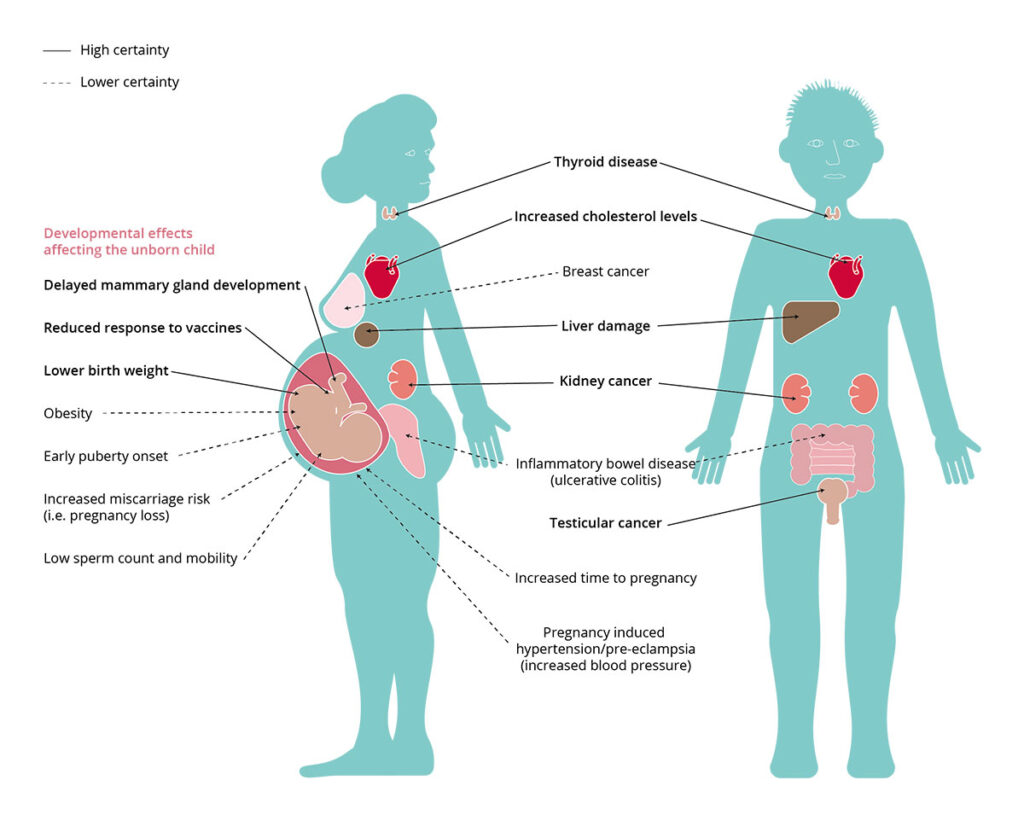
Effects of PFAS on human health.
PFAS is known as ‘forever chemicals’ as they degrade excruciatingly slowly.
They are also ubiquitous and are used in food wrappings and carpets to make them stain-resistant, nonstick coating in pans, cosmetics, paints, pesticides, etc.
This group of chemicals is so common that a study found it in 97% of all blood samples tested.
Now, if you think as I do, you will wonder why the company got sued for a chemical already in the bloodstream of a large portion of the populace.
It turns out that the reason the company got sued (and lost/settled) was not that its product contained PFAS (a chemical we cannot insulate ourselves from) but because of its marketing claim that portrayed its products as “organic, sustainable, and non-toxic”.
It was their misleading advertisement that got them!
Reading such news, I feel affirmed in my choice not to jump in to use any ‘newly launched’ product in the market, esp. those that claim to use ‘new technology’.
Here are some resources on PFAS:
- New York Times article on the aforementioned lawsuit.
- United States Environmental Protection Agency – PFAS Explained.
- National Institute of Environmental Health Sciences – PFAS.
- Environmental Working Group – PFAS Contamination in The USA (June 8, 2022).
- European Environmental Agency – Emerging Chemical Risk in Europe – PFAS.