
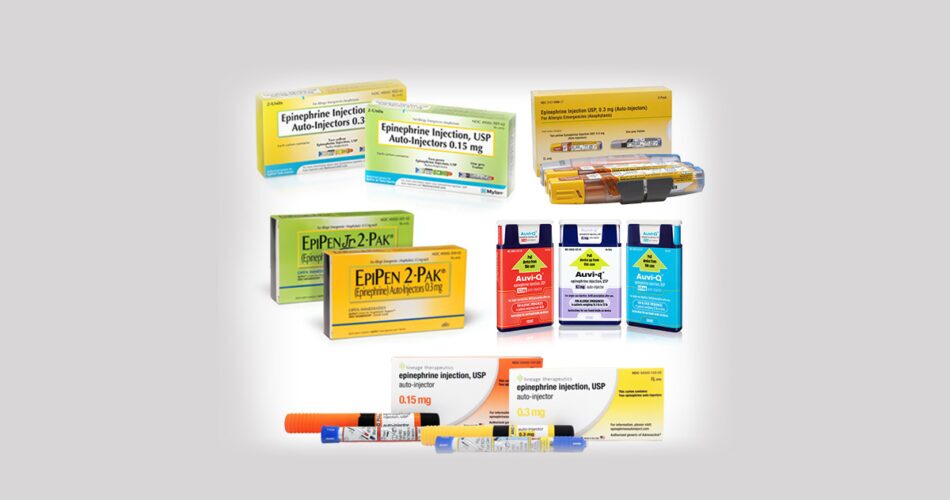
Note: EpiPenTM is a Epihenprine Autoinjector Device. Some other brands are Adrenaclick, Auvi-Q, ltellus, Anapen, Emerade, EpiPen, Fastjekt, FastPen, and Jext.
Quick Navigation
What Does Expiry Date Mean?
The expiration date is the date until which the manufacturer guarantees the potency and safety of the given drug despite exposure to various environmental factors, including temperature, humidity, and light.
The FDA requires that drug expiration dates ensure that the devices contain at least 90% of the original dose of the active component. In this case, Epinephrine.
It is important to remember that the injectors’ epinephrine can degrade more quickly if they’re poorly stored. For example, a pen kept in a car can be subjected to high heat in the summer and freezing cold in the winter, which would affect drug stability.
Click here to learn the proper way to store your medicines.
While many studies have debated and suggested that some drugs can be safely used post-expiry, a consensus is yet to be reached. Click here to know if medicines really expire?!
Can you use an expired EpiPen?

The chemical in EpiPen is Epinephrine (adrenaline) which is an unstable chemical subject to degradation.
EAIs have a relatively short shelf-life, and prescribing information states that they should be stored at 20°C–25°C (68°F–77°F)
The manufacturer states that EpiPen autoinjectors should not be used after the expiration date and even provides ‘expiry alert services’ in certain regions.
https://www.epipen.co.uk/en-gb/patients/expiry-alert-service
https://www.epipen.ca/epipen-expiry-reminder
With a set of it costing around 700 dollars in the USA, and many having to pay it out of pocket, researchers have looked into if expired EpiPens can be used?
A study published in 2000 in The Journal of Allergy and Clinical Immunology evaluated 28 expired EpiPen and EpiPen Junior 1 to 90 months after expired dates. Epinephrine bioavailability (proportion of a drug that enters the circulation when introduced into the body and so can have an active effect) from the outdated EpiPen autoinjectors was significantly reduced compared with epinephrine bioavailability from the in-date autoinjectors.
Another study determined the time point at which epinephrine concentrations fall below 90% ( Note: The FDA requires that drug expiration dates ensure that the devices contain at least 90% of the original dose of active component). Forty-six multibrand EAIs (Epinephrine Autoinjector Devices), including EpiPen ™, were collected from friends, relatives, and colleagues representative of a broad selection of users. EAIs with up to 6 months past the labeled expiration date (4 in number) maintained 100% of the drug. EAIs one year (10 in number) after the labeled expiration date showed at least 95% drug content. All EAIs up to 30 months (27 in number) beyond their labeled expiration dates have shown 90% drug content.
This is, however, very small data, and further investigations are needed before a definite recommendation can be made.
In yet another study published in 2017, researchers collected 40 expired EpiPens from patients and physicians at a community health clinic. None of these pens showed any discoloration. The samples ranged from one month to 50 months over the expiry date. None showed any physical changes. Twenty-four of these contained at least 90% of the stated epinephrine stated, which fits into the FDA regulation of a product being suitable for use. The researchers concluded that “The process for establishing expiration dates for EpiPens should be revised and that, in the setting of outpatient anaphylaxis without other therapeutic alternatives, patients and caregivers should consider the potential benefits of using an expired EpiPen.”
Despite these above studies, it has been reported that patients have died from anaphylactic attacks after being administered epinephrine from an expired EAI. In this particular study, however, even patients with non-expired EAIs died. Furthermore, the objective of this study was to report on food-related anaphylactic death and not EAIs per se.
While the above studies may make it seems that it is okay to use an expired EAI as long as there is no physical change in it (like discoloration or sediments), significant degradation of epinephrine in an EAI can occur in the absence of discoloration or precipitation, indicating that appearance alone should not be used to determine whether an EAI is safe to use.
Thus, it is believed that EAIs should always be replaced before they expire to ensure proper treatment of anaphylaxis.
Does an expired EpiPen have any safety issues?
As mentioned above, the biggest safety issue with an expired EpiPen is that it may not work as it should due to the degradation of epinephrine. This means if you’re experiencing anaphylaxis or another allergic reaction, an expired EpiPen may not stop the reaction like a non-expired one would.
Note: It has been suggested that if an expired EAI is the only source of epinephrine available to treat an anaphylactic event, it may be used as the risk of using a suboptimal dose of epinephrine potentially outweighs the risk of using no epinephrine at all.
Conclusion: Old Epinephrine Is Probably Better Than No Epinephrine
Taking into consideration these studies, it can be stated with caution that when no suitable alternative is available, an outdated EpiPen may be effective, especially in scenarios when there is an emergent need for it, e.g., if someone has an acute severe allergic reaction and only an expired device is available.
However, any medication that shows discoloration, sedimentation, or physical change is probably unsafe to use and should be discarded.
Takeaway
- Anaphylaxis (severe allergic reaction) is a potentially life-threatening condition that needs prompt epinephrine injections, which at the community level, can be delivered by EAIs like EpiPen.
- Some studies have shown EAIs retaining 90% of their potency up to 30 months of expiry, but it is known that epinephrine shows degradation with time, more so if storage conditions have been improper.
- Ideally, expired EAIs like EpiPen should not be used, especially if they show changes like discoloration or sedimentation.
- However, when no other suitable option is available, one may consider using an expired Epipen with full knowledge that it may not work at all or not as well as a non-expired one.
Trivia

Richard B. Toren, one of the creators of EpiPen design, found his motivation in his daughter’s severe allergic reaction to bees- she had to lug around a complex kit in case she was stung. Mr. Toren also devised the Holter (portable device for cardiac monitoring), AtroPen for the military (antidote for nerve gas exposure), and AstroPen for NASA (for motion sickness, bradycardia, and arrhythmia). Talk about genius!