
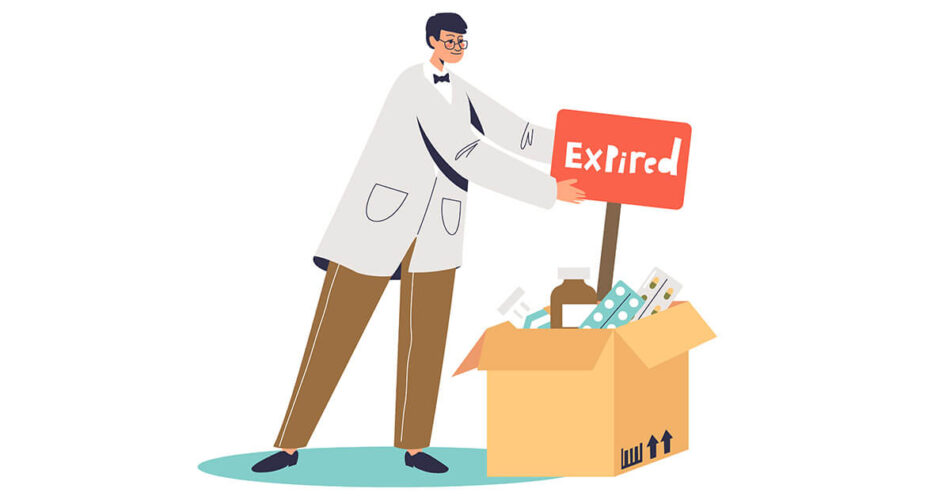
The FDA and NHS say, ‘Don’t be tempted to use expired medicines,’ ‘After the expiry date, medicines may not be safe or as effective.’
So should you really go with that advice, or is it okay to treat your headache with the only painkiller you have at home that expired a month ago?
Quick Navigation
What is expiry date?
This is the date until which the manufacturer guarantees the potency and safety of the given drug despite exposure to various environmental factors, including temperature, humidity, and light. The FDA mandated this in 1979 for both prescription and over-the-counter (OTC) medications.
Why not just junk all expired meds? Why have this debate at all?
Pharmaceutical waste imposes serious ecological, economic, and socio-ethical burdens.
In the USA, a cross-sectional study reported that the value of unused medications generated by the population of US senior citizens alone is estimated to be over USD 1 bn per year.
India, which is slated to overtake China as the most populous country, alone discards 80 million USD of drugs every year.
Even if one were to set aside these financial considerations, disposal of these medications that contain active chemical and often toxic components threatens the ecosystem. Studies have found the presence of these ingredients in soil, waterways, and aquatic animals, which then find their way into the food chain and eventually the human population that discarded them in the first place.
(To know what to do with your unused medications e.g.correct way to dispose or recycle and donate, follow this link)
Furthermore, with UN reporting the death of more than 1.5 million people in Africa due to diseases that could be prevented or treated with affordable medicines- in stark contrast to tons of unused medicines discarded each year in developed countries, this topic begs attention.
(To know how to recycle your unused medications, follow this link)
What does the research say?
The Food and Drug Administration (FDA)- at the military’s request, burdened with a large stockpile of expensive drugs which faced tossing out and replacement every few years- conducted the Shelf Life Extension Program (SLEF) study.
Over 3000 lots, representing 122 different drug products, were evaluated.
Expiry on 88% of the lots was extended beyond their original expiration date for an average of 66 months. Of these, roughly 12% more lots remained stable for at least 4 years after the expiration date. None of these lots failed before 1 year. Common drug products tested with no failures included amoxicillin, ciprofloxacin, diphenhydramine, and morphine sulfate injection.
For most drugs, however, stability beyond expiration showed variability from lot to lot.
A 2012 study by Dr. Lee Cantrell tested drugs that were 28 to 40 years past expiry- 86% of the 14 drugs tested had at least 90% of their labeled potency, which falls within the FDA’s acceptable potency range for drugs within their expiry period.
What drugs can be used post expiry?
The above reports suggest that many drugs may have extended shelf lives beyond their expiration date. However, it is difficult to predict which product in a medicine cabinet could have an extended shelf life or expiration date as this depends on multiple variables like the actual drug ingredients, the form of the drug (liquids degrading faster), preservatives, and storage conditions (humidity, temperature, light). Additionally, the drug lots tested in the SLEP program had been stored in their original packaging. Once a drug is repackaged into another container, as often happens in the pharmacy, the shelf-life could decline due to environmental variations.
(Follow this link to know how to store drugs properly.)
Furthermore, because of legal and liability concerns, your healthcare provider would not be able to give you definite advice to use expired drugs.
Is it harmful to use drugs post expiry?
So far, barring renal failure (Fanconi syndrome) due to degradation products of expired tetracycline (in a formulation that is no longer used in the USA), there are no published reports of expired medicines causing human toxicity due to ingestion, injection, or topical application after its expiration date. (In some countries, this particular formulation of Tetracyline is no longer used)
However, certain formulations like reconstituted liquid oral antibiotics and opened eye drops have the potential to cause harm due to bacterial contamination.
What drug should not be used post expiry?
Following are the common examples:
(Note: this is not a complete and exhaustive list)
- Nitroglycerine is a prescription drug used for relieving angina. It is extremely sensitive to heat and moisture, which can degrade the drug and reduce potency. If you are using it for angina relief, it is important you renew your prescription once the previous one expires.
- Insulin proteins break down over time and using an expired batch will make it less effective, thus making it dangerous.
- Tetracycline expired batches have been reported to lead to kidney damage due to degradation products. Some countries have now stopped the use of this formulation.
- Mefloquine, an antimalarial, degrades with time, rendering it ineffective.
- Reconstituted liquid oral antibiotics are susceptible to bacterial contamination due to the non-sterile compounding process and use of non-sterile liquid.
- Medicated eye drops are susceptible to bacterial and fungal contamination once opened. Always make sure the dropper does not touch any surface.
- Any medication that is intended for use in life-threatening diseases, e.g., Epipen.
For more details on using EpiPen post expiry date, follow this link. - Any drug that has ‘changed.’ For example, liquids showing any precipitates or have turned cloudy or pills that have degraded or show color changes.
- Any medicine that has been specially compounded for you as the compounding process is often non-sterile.
Takeaway
- It is always the best practice to use drugs that have not expired.
- The potency of any medication starts reducing the moment it is manufactured.
- Solid forms (tablets, capsules) are more stable, especially if individually packed like in blister pack strips.
- Drugs in suspension or reconstituted form may not have the potency after the best-by date.
- The reduction of the potency of a drug varies from batch to batch and depends on variable factors.
- Certain drugs, especially life-saving ones, should not be used post expiry unless no suitable other alternatives are available.
- Legally, no one can recommend the use of expired drugs.
Trivia

(Source: engelglobal.com)
The global pharmaceutical packaging market size, valued at USD 117.2 billion in 2021, is expected to expand at a compound annual growth rate (CAGR) of 9.5% from 2021 to 2030. Pharma packaging is a highly customized industry and has to adhere to strict regulatory compliances, especially concerning the sterility of the packaging. North America is the dominant player, with a share of 36.6% in 2021 due to increased production, robust healthcare system, and increased spending on drug development in countries such as the USA. (Source: Grand View Research, pharmaceutical packaging market)