
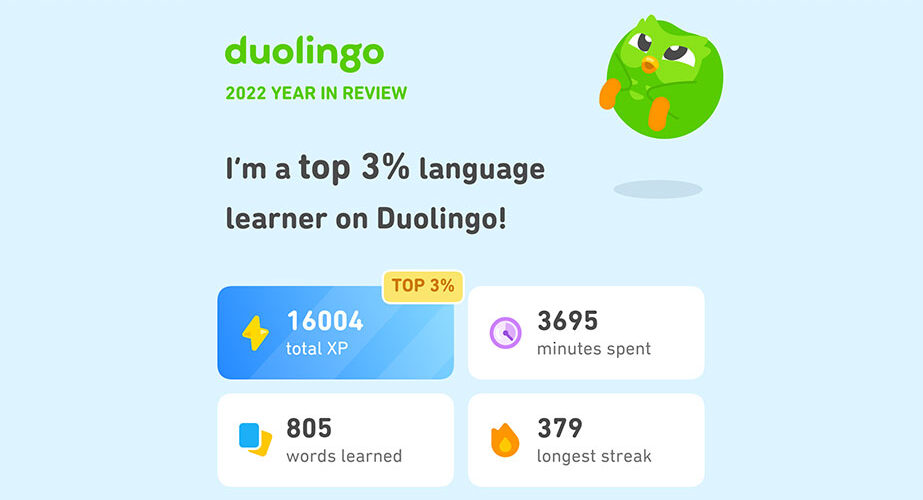
I got my Duolingo stats for 2022 a few days ago. I am a Spanish learner.
I was pleasantly surprised when I found that I am in the top 3% of Duolingo’s 500 million language learners.
(Click here to read Duolingo 2022 Language Report)
Surprised because I dedicate barely 15 minutes of my day to Duo’s Spanish lessons. What I am, is consistent, and I think that has helped my stats.
Spanish is a beautiful language…made prettier by the proximity of the alphabets and words to English 😄
This makes it relatively easier to learn, as compared to, say…Mandarin.
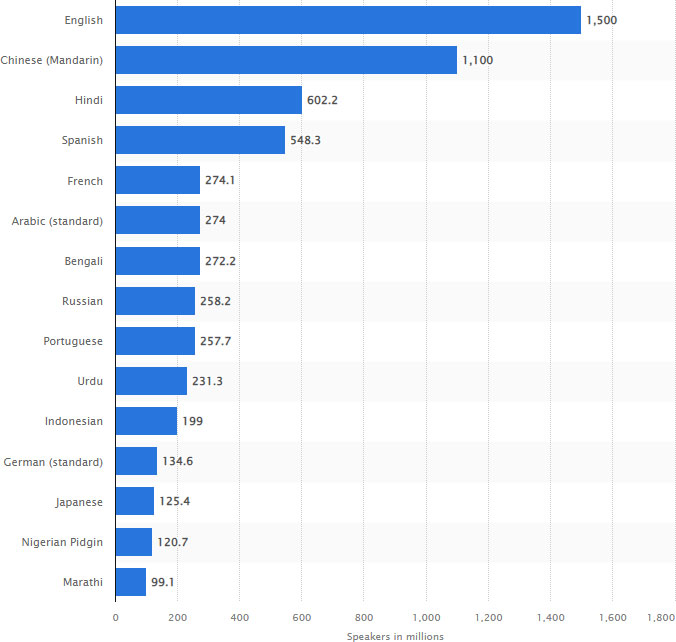
It is also the 4th most commonly spoken language worldwide after English, Mandarin, and Hindi.
French ranks 5th.
My Spanish is still very basic, though, and I hope to be good enough to be able to follow Spanish movies and shows sans the subtitles.
Duolingo has an impressive selection of 56 language courses for the English speaker.
Besides the usual German, French, Mandarin, etc., it also has Esperanto, Klingon, and High Valyrian!
And how about Navajo, Yiddish, Zulu, and Xhosa (had to look up this last one online!)?
(P.S. This is not a paid ad for Duolingo.)
I decided to learn Spanish on a bright summer day when I arrived early to pick up my nephew from his preschool. I was allowed to watch them at play, and the absolute joy on the faces of the kids screaming their lungs out the colors in Spanish from a chart (amarrrrriiiiiiiiii…..LO) and singing ‘itsy bitsy spider’ in Spanish enthused me to learn Spanish.
However, all that enthusiasm didn’t translate to real life till I watched Narcos. And unfortunately, the first Spanish word that really stuck with me, thanks to Narcos, was P*ta.
I like to think it is because it is close to the word for father in Hindi (Pita) or son in Punjabi (Puttar), but…well…(shrugs)
Besides the obvious benefits of using swear words on unsuspecting people and (hopefully) getting away with it, learning a new language comes with many benefits:
- Sharper memory,
- Improved ability to multitask,
- Protection against age-related decline like dementia,
- Better visual-spatial processing,
- Enhanced creativity.
This is just a very, very short list of benefits being multilingual confers on you.
Here is a shorter list of some unique and fascinating studies on multilingualism:
- 53 English and 53 English and French speaking children were equally matched for socioeconomic status and verbal and nonverbal intelligence and given a series of tasks. The bilingual group performed significantly better.
- Delayed onset of Alzheimer’s- Bilingual Alzheimer’s patients showed initial symptoms at 77.7 years vs. 72.6 for the monolingual group.
Bilingual and monolingual Alzheimer’s patients who matched equally on years of education and cognitive performance were compared on the physical structure of their brains. The CT scans, surprisingly, showed a more significant degeneration in the bilingual group! To put it in other words, although the bilingual brain had worse brain degeneration and should, thus, have worse symptoms, they performed at par with the monolinguals.
To quote one of the authors of the study, “If the brain is an engine, bilingualism may help to improve its mileage, allowing it to go farther on the same amount of fuel.” - Bilingual people are better are handling tasks that come with conflicting choices, like the Stroop Test, where you are shown a word and are asked to name the color it is written in. E.g., BLUE or GREEN.
(Click here to take the Stroop Test)
If you think that now you are too old to derive any benefit from learning a new language, studies have shown that the gains listed above (and more!) are not just the purview of those raised bilingual but are also seen in those who learn a second language later in life.
Maybe just start with swear words, as I did, and see where it takes you!
Trivia
Multilingual and a frequent sufferer of ‘tip-of-the-tongue’ syndrome? This study shows it is not your fault!