
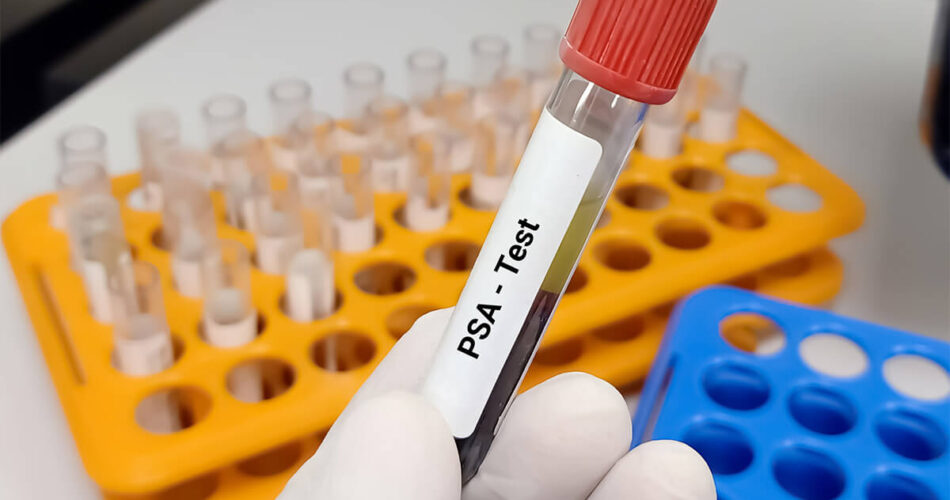
Prostate cancer is the fifth leading cause of male cancer-related deaths worldwide, accounting for 1,414,000 newly diagnosed cases and 375,304 deaths annually.
It is the second most common cancer in men in the USA after non-melanoma skin cancer.
In 2019, 224,733 new cases were reported in the United States, and 31,636 died. For every 100,000 men, 112 new cases were reported, and 18 died.
Quick Navigation
What is the PSA test?
Prostate Specific Antigen (PSA) is a protein that is made in the prostate gland and released in the semen to make it watery and, thus, easier for the sperm to swim.
The prostate is a vascular organ, and a small amount of the PSA typically leaks into the bloodstream. In the event of diseases of the prostate (both non-cancerous and cancerous) or trauma, the levels of PSA rise, and more of it leaks into the blood.
This leaked PSA in your blood is estimated for prostate cancer screening.
Typically, in diseases of the prostate, the PSA level increases.
Why can PSA levels be confusing?
Although widely used in prostate cancer screening, the PSA test is not perfect and suffers from a lack of specificity for cancer.
The PSA level can rise in all prostate pathologies – infection, trauma, and cancer, to name a few.
It also rises after vigorous exercise, UTI, medication, anal sex, or any prostatic stimulation.

Due to this nonspecificity, only the PSA level is not taken at face value, and other factors are also considered:
- Age – prostate cancer is rare in under 40 age and 60% of cases are in men older than 65.
- The gland size – generally, the size of the gland enlarges.
- Rapidity with which PSA level is changing.
- Use of medications that affect PSA values, such as finasteride (Propecia, Proscar) and dutasteride (Avodart).
- Ethnicity – African Americans are 50% more likely to develop prostate cancer and twice more likely to die from it.
- Family history of prostate cancer. About 10–15% of younger men who develop prostate cancer have a positive family history of the disease.
How to interpret your PSA value?
In the past, a PSA value of 4 ng/ml and lower were considered normal, but there is a big gray area, and some individuals with PSA levels below 4.0 ng/mL have prostate cancer, and many with higher PSA levels do not.
Serum PSA levels typically increase with age; thus, age-specific ranges have been defined instead of a blanket value of 4ng/ml. These age-specific ranges are as follows:
- 40 to 49 yrs: 0 to 2.5ng/ml
- 50 to 59 yrs: 0 to 3.5ng/ml
- 60 to 69 yrs: 0 to 4.5ng/ml
- 70 to 79 yrs: 0 to 6.5ng/ml
High PSA levels can signify cancer but may also be caused by many other conditions because, in response to any disease or irritation, the prostate gland secretes more PSA into the bloodstream.
For instance, high PSA levels may result from
- Inflammation of the prostate (prostatitis),
- a benign enlarged prostate (benign prostatic hyperplasia),
- a urinary tract infection (UTI),
- pressure on the prostate, for example, after riding a bicycle, or after a doctor has examined the prostate gland by feeling it with a finger (palpation) or doing an ultrasound scan,
- ejaculation.
It is a good idea to let the doctor know if any of the above have recently occurred so that the test results can be interpreted correctly or the test can be postponed.
Very high PSA, over 10 ng/ml, is probably due to prostate cancer. PSA levels are not always that high, though.
PSA may also be considered abnormal if it increases over time. For example, if your score rises more than 0.35 ng/ml in a single year, you may need further evaluation.
The problem with PSA for screening.
The PSA test may give a false positive result.
This is when the levels are elevated, but there is no actual cancer, leading to anxiety for the patient and the family. Furthermore, this might lead to additional procedures like prostate biopsy, which is invasive and comes with its own set of possible complications.
This is a common issue with PSA testing: only about 25% of those who undergo biopsy following high PSA value are found to have cancer.
Detection of prostate cancer does not change overall mortality.
Unlike many other cancers, prostate cancer often progresses very slowly, and it can take up to 15 years for it to spread outside the prostate. In many cases, prostate cancer won’t affect a man’s natural life span.
As a screening tool, PSA can help detect early prostate cancer, which, even if treated, may not reduce the chances of dying from it. This is because many tumors found through the screening are very slow growing and are unlikely to be life-threatening.
These tumors, left untreated, would have gone undiagnosed in the patient’s lifetime.
Treatment of such tumors exposes a person to the potential and serious complications associated with prostate surgery and radiation therapy. These include urinary incontinence following surgery or increased frequency and urgency of urination following radiation, gastrointestinal (e.g., loose stools, rectal bleeding post-radiation), and erectile dysfunction following both surgery and radiation.
As noted at the beginning of this post, PSA is not a perfect test, and some may find that they were better off not doing the PSA! It is essential to assess with your doctor your risk and the potential benefits before you get tested.
| Pros of PSA screening | Cons of PSA screening |
|---|---|
| Early detection of cancer. | Some cancer grow very slowly and will not spread beyond the prostate. |
| Sensitive test. | Not specific. Levels can also rise in non-cancerous conditions, but when raised, warrant other tests like an invasive biopsy. |
| Cancer detected in the early stage has a higher likelihood of cure. | Not all prostate cancer needs treatment, and treatment can have side effects like urinary incontinence and erectile dysfunction. |
| Improved survival in cancer detected early. | For the vast majority, overall survival is not changed for at least the first ten years after initial diagnosis, and for some, the diagnosis can lead to unnecessary treatments. |
| The testing process is simple and only requires a blood draw. | The levels of PSA are open to a lot of interpretation, and because you dont have a raised level does not prove you have cancer or vice versa. |
| Normal levels are assuring. | Abnormal levels may cause anxiety. It is mostly very slow growing and can make decision-making hard because of the possibility of serious complications with the treatment. |
How should you prepare before your PSA testing?
PSA testing procedure is like any other blood test and involves drawing a sample of your blood from your arm.
There is no food or beverage restriction before undergoing the test.
Follow these guidelines to ensure your PSA test result is accurate:
- Avoid vigorous exercise (e.g., cycling, horse riding, etc.) two days before.
- Avoid ejaculation 2 days before testing.
- Inform your doctor if you recently had or are on treatment for.
- Benign prostate enlargement or hypertrophy (BPH).
- Urinary tract infection or burning during urination.
- Had any of the following procedures in the last 6 weeks:
- Any prostate procedure like biopsy or surgery.
- Urinary catheter insertion.
- Cystoscopy
- If you are on the following medications:
- For prostate enlargement
- Statins for high cholesterol
- Chemotherapy drugs
- NSAIDs (nonsteroidal anti-inflammatory drugs)
- Herbal supplements.
What is DRE?
PSA testing is sometimes combined with a digital rectal exam (DRE) to feel the prostate for abnormalities physically.
During the DRE, the doctor gently puts a lubricated, gloved finger of one hand into the rectum and feels your prostate for size, consistency, texture, or any abnormality like nodularity, hardness, variable consistency, or asymmetry of the gland. DRE alone is not recommended to screen for prostate cancer without PSA testing as the sensitivity and specificity are low.
Takeaway
- PSA level is the most widely used test for prostate cancer screening.
- It is normally secreted by the prostate, with values increasing in the case of prostate disease (both cancerous and non-cancerous) and trauma.
- There is no standard level of abnormal PSA level that is diagnostic for cancer.
- Prostate cancer, in general, tends to grow very slowly and may not even affect a man’s natural life span. At the same time, treatment is associated with the possibility of serious complications.
- PSA testing should be done only after consultation with your doctor and assessment of your risk for it.